
Kelvin Waves Across The American Coast

Of all the El Niño news stories coming out of the US, one of the more unusual ones is the mysterious waves currently fanning up and down the west coast of the Americas.
Though unusual, those waves help us understand how El Niño works, and how its effects radiate out from the immediate area.
El Niño events are effectively a redistribution of heat. The atmosphere temporarily reorganises, so it tries to find a new balance, and so does the ocean.
During neutral periods (not El Niño or La Niña) easterly trade winds cause warm water to pile up in the west Pacific, while also elevating the sea levels there. As the trades ease and El Niño kicks in, the Pacific Ocean balances the 'pile' of warm water, sending it east, along the equator, towards the Americas.
These waves of warm water are known as Kelvin waves.
Right now, the warm water is straddling the equatorial Pacific, broadly from Kiribati to the American continent. To further understand what's happening it's important to note that warm water is less dense than cold water, which results in warmer water taking up more area.
This is known as thermal expansion, and when talking about an area covering tens of thousands of square kilometres wide - such as the warm tongue of El Niño in the eastern Pacific - the result is sea level rise.
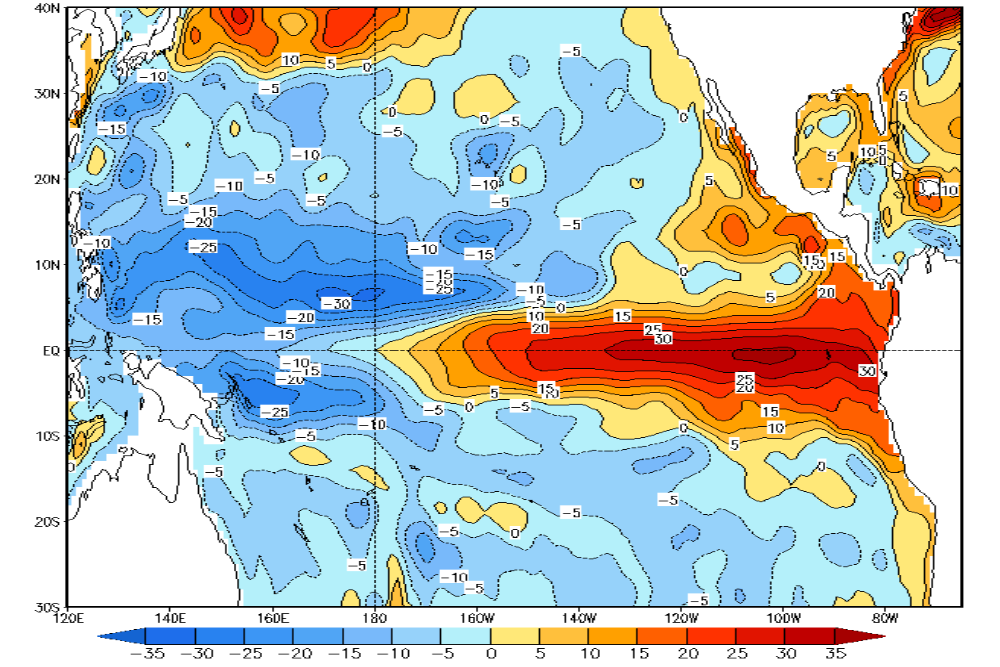
Sea level anomaly across the Pacific basin. Red = higher than normal, blue = lower (NOAA)
For some perspective, parts of the equatorial Pacific are currently lifted 30-35cm higher than normal. Now, all things being equal the Earth tries to balance this by then spreading the equatorial Kelvin wave north and south along the Americas.
These are known as coastal Kelvin waves, which are essentially slow moving waves of heightened sea level. Coastal Kelvin waves travel much slower than the waves we surf. On average they travel at 10km/h (6mph) while the waves we ride are between 30-40km/h (18-25mph).
A better comparison is to tides and tidal movement, and in fact a tide propagating along a coast is also a type of Kelvin wave.
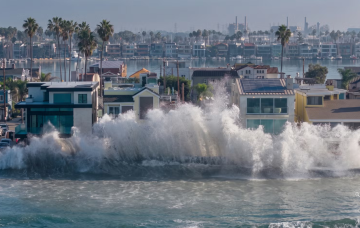
As a result, these waves aren’t surfable or even visible unless you're paying very close attention to the shoreline level. They appear more as a lift in the nominal sea level above the local tide signal and can last for a few weeks, bringing an increase in coastal inundation and flooding if they coincide with a larger swell event.
At the moment satellite observations reveal a bulge along the Mexican and Californian coast of about 15cm (6 inches), while a larger Kelvin wave, measuring 30cm (12 inches) is off Peru.
A great way to keep track of the difference between the expected tide height and any additional Kelvin wave influence is to use NOAA’s water level monitoring stations across the coast.
Using San Diego as an example - see graph below - the current sea levels (red line) are 20cm (0.7ft) above the predicted tidal range (blue line)., This information becomes useful when planning a surf around tidally sensitive breaks.
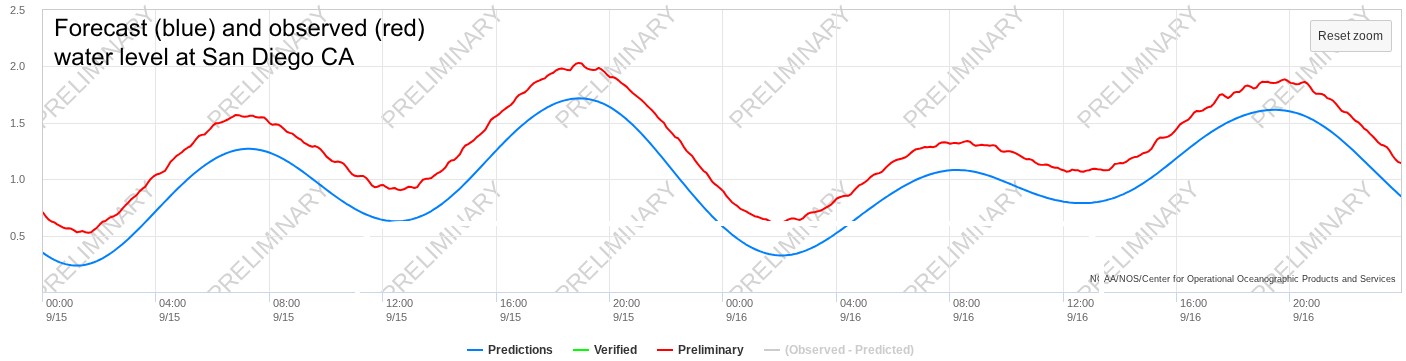
Forecast and observed water levels at San Diego. Note the observed is 20-30cm above forecast (NOAA)
Over the coming months we’ll likely see multiple Kelvin waves bulging up and down the coast so stay in tune with them using the local water level observations.
You can also check out the San Diego surf forecast (and current tide predictions), along with other Californian surf and tide forecasts.
Comments
wheres ben gravy to prove that kelvin waves can be ridden
Bahaha niceone... Or maybe weird waves episode 42 incoming...
Super interesting...
Craig when do you think the el nino will revert back to neutral?
as long as there is enough rain, hopefully never. surf coast has been pumping
Fascinating as always Craig, cheers
Do Kelvin waves hum? https://www.abc.net.au/news/2026-08-28/could-ocean-waves-be-making-eart…
There is a seismograph on an ancient fault 50km inland, that picked up a very low pulse a few times an hour for years. I was told by the scientists from Geo-science Australia, after replacing batteries & reading the long spools of graph paper, that the 'pulse/wave' was the swell hitting the coast. The planet pulses, mixed with occasional spike from mining & military blasts & the land down under.
Lucky Country
that was a great written article mate loved it
Sea level anomalies hit 34cm off San Diego yesterday and is persisting into today, that's over 1ft and would be making quite an impact across most surf spots.